by admin | Lifestyle & Wellness
Strength has long been measured by how much we can endure.
How much we can carry without breaking. How well we can stay composed under pressure. How quickly we can recover and move on. Somewhere along the way, resilience became synonymous with silence, and survival was mistaken for success.
Soft living invites us to question that definition.
What if strength isn’t about pushing through at all costs but about knowing when not to?

The Quiet Misunderstanding of Softness
Softness is often misunderstood as fragility. As indecision. As a lack of discipline or drive. We associate gentleness with vulnerability, and vulnerability with risk. So we harden ourselves instead – our schedules, our boundaries, our emotions, believing that firmness is what keeps us safe.
But hardness is not the same as strength.
True strength does not require constant tension. It does not demand self-denial. It does not ask us to abandon our inner experience in order to appear capable.
Softness, in its truest form, is the ability to remain open without collapsing. It is presence without defensiveness. It is choosing to stay connected to yourself even when the world asks you to move faster than your nervous system can handle.
Strength That Begins Inside
Redefining strength means shifting from external performance to internal alignment.
It looks like:
-
acknowledging exhaustion instead of masking it
-
honoring emotions instead of minimizing them
-
choosing rest without explaining yourself
-
setting boundaries that protect your energy, not your image
This kind of strength is quiet. It doesn’t announce itself or seek validation. It shows up in the moments no one sees—when you pause before reacting, when you listen to your body, when you choose compassion over self-criticism.
Softness becomes strength when it is grounded in self-trust.
Why Soft Strength Feels Uncomfortable at First
For many of us, softness feels unfamiliar because it requires us to let go of control. If we’ve learned that being strong keeps us safe, then easing our grip can feel like exposure.
We may fear that if we stop pushing, everything will fall apart.
But what often happens instead is the opposite. When we stop forcing ourselves through life, clarity returns. Energy replenishes. Decisions feel less urgent and more intentional. The body relaxes, and with it, the mind.
Soft strength doesn’t remove responsibility, it removes unnecessary resistance.
Practicing Strength Without Hardness
Living softly doesn’t mean abandoning discipline or purpose. It means practicing them with respect for your limits.
You might notice soft strength when:
-
you take a break before burnout demands it
-
you allow emotions to pass without judgment
-
you speak honestly without over-explaining
-
you choose steadiness over urgency
These choices may seem small, but over time they reshape how you relate to yourself—and to the world.
A New Definition of Resilience
Resilience is not how quickly you bounce back.
It is how safely you stay with yourself during difficulty.
Soft living teaches us that we do not need to be hard to be capable. We do not need to suffer to be worthy. We do not need to prove our strength by ignoring our needs.
There is power in listening.
There is courage in slowing down.
There is strength in choosing gentleness again and again.
Softness is not weakness.
It is strength that has learned to breathe.

by admin | Feature, Lifestyle & Wellness
We live in a world that moves quickly and praises those who can keep up.
Faster replies. Fuller calendars. Sharper edges. We are taught sometimes subtly, sometimes loudly, that resilience looks like endurance, that strength sounds like certainty, and that slowing down is something we can do later, once everything is handled.
But later rarely comes.
Soft living begins with a quiet rebellion: the choice to stop rushing yourself through your own life.
It doesn’t announce itself with dramatic changes or bold declarations. Instead, it arrives gently in the moment you pause before saying yes, in the breath you take before reacting, in the permission you give yourself to rest without justifying it. Soft living is not about withdrawing from the world. It is about engaging with it differently.
Why Softness Feels Unfamiliar
For many of us, softness doesn’t feel natural at first, it feels unsafe. We’ve learned that being alert keeps us protected, that staying busy keeps us relevant, that being “on” keeps us needed. Over time, urgency becomes a habit, and tension becomes the baseline.
Soft living asks us to loosen that grip.
Not all at once. Not recklessly. But intentionally.
It asks us to notice how often we brace ourselves against life—how often we rush moments that don’t need rushing, override feelings that ask to be felt, or push past limits we promised ourselves we’d honor. Gentleness can feel like vulnerability, and vulnerability can feel risky when you’ve spent years being strong.
Yet softness is not the absence of strength.
It is strength that no longer needs to prove itself.
Soft Living Is Not Giving Up
There is a common misunderstanding that to live softly is to opt out to care less, to try less, to become passive. In truth, soft living requires discernment. It asks you to choose where your energy goes instead of scattering it everywhere. It invites you to be present instead of productive for the sake of appearance.
Soft living looks like:
-
listening to your body before it demands your attention
-
responding instead of reacting
-
allowing rest to be restorative, not strategic
-
choosing clarity over constant effort
It is not a collapse. It is a re-calibration.
The Body Knows the Way
One of the most powerful shifts that comes with soft living is the way the body begins to speak and be heard. When we slow down, we notice the subtle signals: the shallow breath, the tight jaw, the fatigue that isn’t physical but emotional.
Soft living is learning to respond to those signals with care instead of criticism.
Instead of asking, “Why can’t I keep going?”
we ask, “What do I need right now?”
This shift alone changes everything. The nervous system softens. The mind quiets. Decisions become clearer. Life feels less like something to survive and more like something to inhabit.
Gentleness as a Daily Practice
Soft living isn’t a one-time decision—it’s a daily practice.
It’s choosing one small kindness toward yourself each day.
It’s letting pauses exist without filling them.
It’s trusting that not everything needs to be solved immediately.
Some days, soft living will look like rest.
Other days, it will look like honesty.
And sometimes, it will look like courage, the courage to stop performing strength and simply be present.
A Different Measure of a Good Life
What if success wasn’t measured by how much you could carry, but by how well you could care for yourself while carrying it?
Soft living invites us to redefine a good life not by speed, output, or endurance but by sustainability. By emotional truth. By the ability to remain connected to ourselves even when life feels demanding.
This is not about escaping responsibility.
It’s about meeting responsibility with self-respect.
In choosing softness, you are not falling behind.
You are choosing to stay with yourself.
And in a world that constantly pulls us away from our own center, that choice may be the most powerful one of all.
Photo by Tatyana Rubleva on Unsplash
by admin | Lifestyle & Wellness, Uncategorized
There is a quiet moment that happens around a dinner table, a pause between passing the rice and wiping little faces, where the whole room seems to breathe.
That’s when Harvard researcher Tyler VanderWeele, co-director of the Initiative on Health, Spirituality, and Religion at the Harvard T.H. Chan School of Public Health and his family, name one thing they’re grateful for. It doesn’t have to be profound, sometimes it’s a restful night’s sleep, sometimes it’s sunshine after rain. And yet, this simple habit shapes something deeper: connection, presence, and the feeling that life, even on the rough days, still offers something to hold onto.
Gratitude doesn’t erase the hard moments — it creates space for life to feel bigger than them.
How Gratitude Shapes the Way We Feel — and Live
Over the years, researchers have been drawn to gratitude because of its subtle but powerful effect on well-being. Scientific studies have linked gratitude to:
But recent research from the long-running Nurses’ Health Study adds a new dimension to the story, gratitude may be linked to longer life.
This is the first time gratitude is being studied not just as a feeling, but as a potential contributor to longevity.
The Study: Gratitude and a Longer Life
In 2016, more than 49,000 women, all participants in the Nurses’ Health Study, with an average age of 79, answered a six-item questionnaire about gratitude.
The questions were simple statements like:
“I have so much in life to be thankful for.”
Researchers then followed their medical records for the next four years. In that time, 4,608 participants passed away, largely from cardiovascular disease — the leading cause of death globally.
The Findings
Those who scored in the highest range of gratitude had a 9% lower risk of death during the study period than those with the lowest gratitude scores even after accounting for age, health, income, and mental well-being.
Nine percent may sound modest, but consider what it represents:
No medication.
No equipment.
No annual subscription.
Just consistent appreciation for life.
Anyone, at any season of life, can practice gratitude.
Why Might Gratitude Make a Difference?
Researchers can’t yet say precisely how gratitude influences longevity, but there are meaningful theories:
-
It increases daily happiness, which can affect health outcomes
-
It encourages better self-care, like seeing a doctor or eating well
-
It strengthens relationships and social support, which we know protect mental and physical health
In a world always pressing forward, gratitude pulls us back into what’s here now — and what’s still worth caring for.
The Limitations
It’s important to acknowledge what this research doesn’t say:
-
It’s observational — meaning it shows association, not direct cause
-
Participants were mostly white, older women in health professions
So more research is needed to understand how gratitude affects men, younger people, and more diverse communities.
Still, the strength of the study lies in its large sample size, and the extensive health data available. It suggests something real is happening even if we don’t yet fully understand it.
A Daily Ritual to Invite Gratitude
If you don’t feel particularly grateful today — that’s okay. Gratitude isn’t a mood; it’s a practice.
And like all practices, it can be nurtured.
Here are six gentle questions that can open the door:
-
What happened today that made me smile, even a little?
-
What am I surrounded by that I’ve gotten used to, but would miss if it disappeared?
-
Who in my life consistently shows up for me in big or small ways?
-
What story, show, or moment recently made me feel inspired?
-
What am I looking forward to this week and why does it matter to me?
-
What is the kindest thing someone has done for me lately?
Let them be felt, not just answered.
Practices for a Gratitude-Centered Life
Here are small ways to let gratitude breathe into your day:
The Dinner Ritual
Like VanderWeele’s family, begin or end meals with one sentence of gratitude.
The Thank-You Letter
Write a letter to someone who shaped you even if you never send it.
The Savoring Pause
Stop in the middle of your day, look around, take in the texture of the moment, and let yourself notice what is good.
Gratitude is simply noticing and honoring the life happening in front of you.
One Small Practice, A Bigger Life
A 9% reduction in mortality won’t make headlines like a breakthrough drug. But when something so simple, so gentle, and so accessible has a measurable impact, it reminds us of something profound:
Life doesn’t just grow in the grand gestures.
It expands in the quiet acknowledgements of what we already have.
Gratitude is the whisper that says:
This moment matters. This breath matters. This life as it is, is worth loving.
And always remember that: Gratitude is a lifestyle.
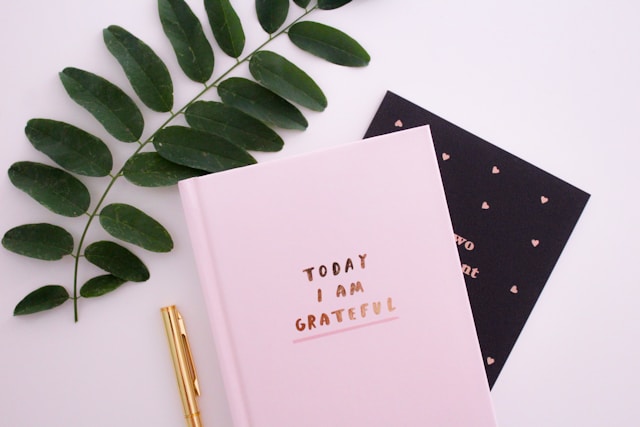
Photo by Gabrielle Henderson on Unsplash